How to File DoorDash Taxes for the First Time (2026 Step-by-Step Guide)
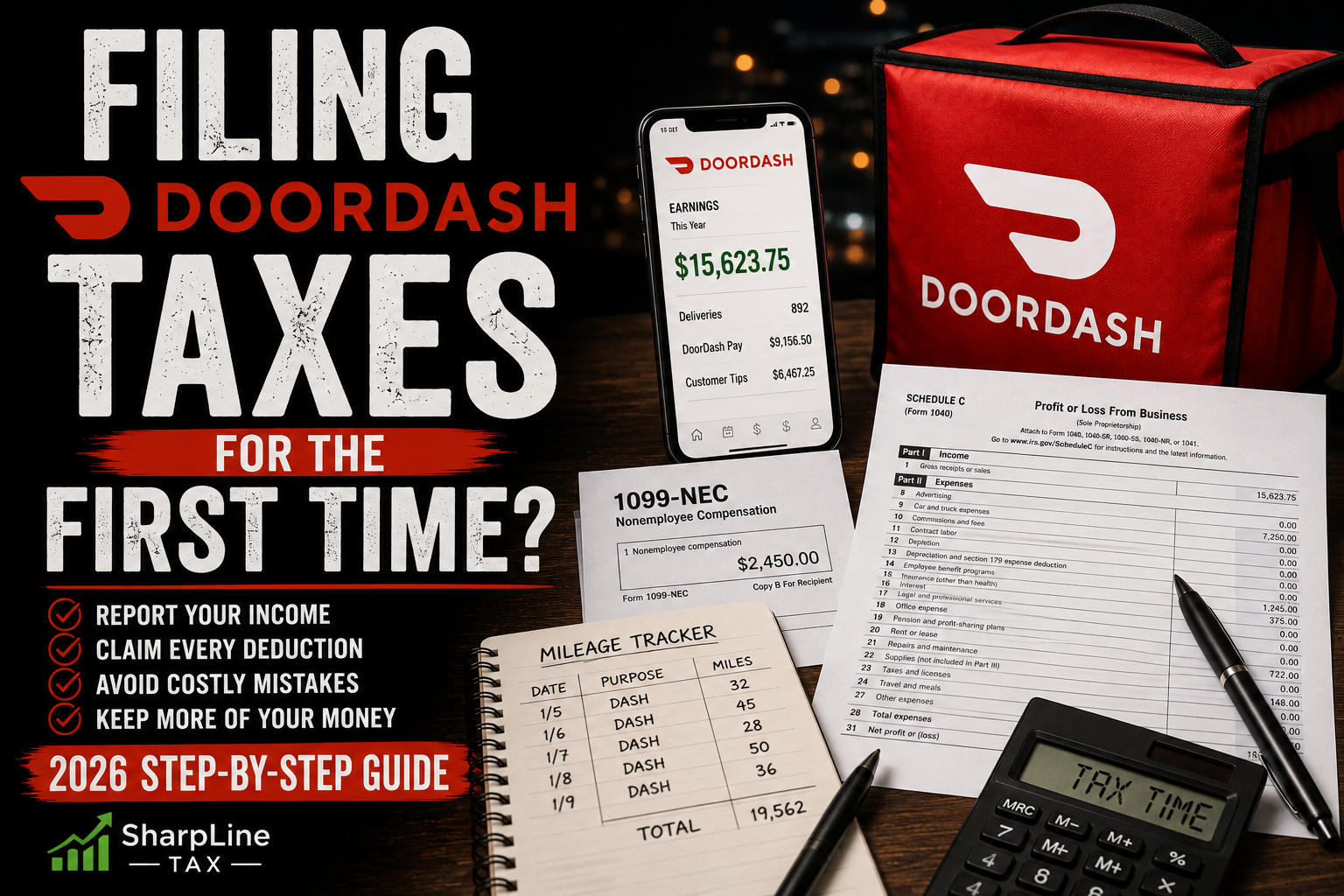
Filing taxes for DoorDash for the first time can feel confusing.
You may have questions like:
Where do I report my DoorDash income?
What expenses can I deduct?
What if I didn't receive a 1099?
Do I have to pay self-employment tax?
What happens if I also have a regular W-2 job?
The good news is that DoorDash taxes become much easier to understand once you break the process into steps.
This guide walks first-time DoorDash drivers through the basic federal tax-filing process for 2026.
Step 1: Understand That You're Generally Self-Employed
DoorDash drivers are generally independent contractors rather than DoorDash employees.
That means DoorDash generally isn't withholding federal income tax, Social Security tax, or Medicare tax from your delivery payments like a traditional employer would.
Instead, you're generally operating your own small business.
For many Dashers operating as sole proprietors, business income and expenses are reported on:
Schedule C — Profit or Loss From Business
Schedule C becomes part of your individual federal income tax return.
You don't need to create an LLC just because you started delivering for DoorDash.
Step 2: Figure Out How Much You Earned
Before you start worrying about deductions, determine how much money you actually received from your DoorDash activity.
Gather your:
DoorDash earnings records
Weekly payout records
Bank deposit records
Tax forms
Records of any other payments related to your DoorDash activity
If you also drove for Uber Eats, Spark, Instacart, Grubhub, Amazon Flex, or another platform, gather those records too.
Don't rely exclusively on a 1099.
Your own records are an important part of determining your business income.
Step 3: Gather Your 1099 Tax Forms
Depending on how your payments were processed and your particular situation, you may receive one or more tax information forms.
These could potentially include forms such as:
Form 1099-NEC
Form 1099-K
Other applicable tax documents
Beginning with certain payments made during 2026, the federal reporting threshold for Form 1099-NEC increased from $600 to $2,000.
But this is extremely important:
The 1099 reporting threshold is not a tax-free income threshold.
You may still have income that needs to be reported even if you don't receive a 1099.
Step 4: What If DoorDash Doesn't Send You a 1099?
Don't assume you're off the hook.
Not receiving a tax form doesn't automatically mean your DoorDash income doesn't need to be reported.
You should use your own accurate earnings records when preparing your return.
For example, suppose you earned $1,500 delivering during the year but didn't receive a particular 1099.
That doesn't automatically make the $1,500 disappear for tax purposes.
This is one of the most common mistakes first-time gig workers make.
Step 5: Gather Your Mileage Records
For many DoorDash drivers, vehicle use can create one of their largest business deductions.
That's why mileage records are extremely important.
For 2026, the IRS business standard mileage rate is:
January 1 through June 30, 2026: 72.5 cents per business mile
July 1 through December 31, 2026: 76 cents per business mile
Because the IRS increased the rate during 2026, drivers using the standard mileage method need records that allow their qualifying business miles to be separated between the two periods.
For example, don't simply take your total annual business mileage and multiply all of it by one rate.
Keep accurate mileage records throughout the year.
Step 6: Understand Standard Mileage vs. Actual Vehicle Expenses
There are generally two methods for calculating deductible vehicle costs:
Standard mileage method
or
Actual expense method
With the standard mileage method, eligible taxpayers calculate their vehicle deduction using their qualifying business mileage and the applicable IRS mileage rate.
With the actual expense method, you track eligible vehicle expenses and determine the portion attributable to business use.
Actual vehicle expenses can potentially include items such as:
Gas
Insurance
Repairs
Maintenance
Tires
Depreciation
Registration fees
Lease payments, when applicable
You generally don't use the standard mileage method and then separately deduct expenses already incorporated into that mileage rate, such as gas, insurance, repairs, and maintenance.
There are also rules affecting when you can choose or switch methods.
Step 7: Gather Your Other Business Expenses
Your car isn't necessarily your only DoorDash business expense.
Depending on your situation, other potential business expenses may include:
Business-use portion of your cell phone
Phone mount
Car charger
Delivery bags
Certain business software
Qualifying business parking
Qualifying business tolls
Other ordinary and necessary business expenses
Don't automatically deduct something just because you bought it while you were a DoorDash driver.
The expense needs to qualify as a business expense, and personal portions generally aren't deductible as business expenses.
Keep your receipts and records.
Step 8: Calculate Your DoorDash Business Profit
This is one of the most important concepts for a first-time DoorDash driver.
Your taxes aren't based simply on the amount of money that hit your bank account without considering allowable business expenses.
A simplified Schedule C calculation looks like this:
Business Income
minus
Allowable Business Expenses
equals
Business Profit or Loss
For example:
DoorDash income:
$20,000
Allowable business expenses:
$8,000
Simplified business profit:
$12,000
The $12,000 is much different from simply assuming you have $20,000 of business profit.
That's why properly tracking legitimate business expenses matters.
Step 9: Report Your DoorDash Business on Schedule C
For many DoorDash drivers operating as sole proprietors, Schedule C is where the business comes together.
You'll generally report your:
Business income
and
Allowable business expenses
Schedule C then calculates the profit or loss from your business.
That result flows into your individual federal income tax return.
Schedule C is not a separate individual tax return.
It's part of your Form 1040 filing.
Step 10: Understand Self-Employment Tax
This is one of the biggest differences between being an employee and being an independent contractor.
Traditional employees generally have Social Security and Medicare taxes withheld from their paychecks.
DoorDash generally doesn't do that for independent contractors.
If your total net earnings from self-employment are $400 or more, you generally use Schedule SE to calculate self-employment tax.
The self-employment tax rate is generally 15.3%, consisting of:
12.4% Social Security
plus
2.9% Medicare
However, don't simply multiply every dollar DoorDash pays you by 15.3%.
Self-employment tax calculations are based on net earnings from self-employment and involve additional rules.
Step 11: Add DoorDash to Your Form 1040
Your DoorDash activity ultimately becomes part of your individual federal income tax return.
For a typical sole proprietor, that means your return may include:
Form 1040
plus
Schedule C
and potentially
Schedule SE
along with any other schedules and forms required by your particular tax situation.
You don't generally file one personal tax return for DoorDash and another personal tax return for everything else.
Your different sources of income come together on your overall federal tax return.
Step 12: What If You Also Have a W-2 Job?
This is extremely common.
Suppose you work a regular job Monday through Friday and DoorDash on nights and weekends.
You might receive:
Form W-2 from your employer
plus
DoorDash business income
Your W-2 wages and DoorDash business activity generally become part of the same individual federal income tax return.
The major difference is that your employer generally withholds taxes from your W-2 paycheck.
DoorDash generally doesn't withhold taxes from payments to you as an independent contractor.
Depending on your situation, withholding from your W-2 job may help cover some or all of the tax associated with your other income.
Step 13: Do You Need to Make Quarterly Estimated Tax Payments?
Not every DoorDash driver automatically needs to send the IRS a payment every quarter.
Whether estimated payments are necessary depends on your overall tax situation, including factors such as:
How much tax you expect to owe
W-2 withholding
Other income
Credits
Prior-year tax information
Other payments
The federal income tax system is generally pay-as-you-go.
Some self-employed people make estimated tax payments during the year because taxes aren't being withheld from their business income.
If you also have a W-2 job, adjusting your withholding can sometimes be another way of covering additional expected tax.
Step 14: Don't Forget About State and Local Taxes
This guide focuses primarily on federal taxes.
Your state may have its own:
Income tax rules
Filing requirements
Estimated payment requirements
Local tax requirements
Business-related rules
Where you live and where you perform your gig work can matter.
Don't assume that completing your federal return automatically takes care of every state or local filing obligation.
A Simple First-Time DoorDash Tax Example
Let's put the process together.
Suppose a first-time DoorDash driver earned:
DoorDash income: $15,000
They determine they have:
$5,500 of allowable business expenses
Their simplified Schedule C profit would be:
$15,000 − $5,500 = $9,500
The driver would generally report the business income and expenses on Schedule C.
Because the net earnings from self-employment exceed $400, Schedule SE would generally also be relevant for calculating self-employment tax.
That business activity then becomes part of the driver's overall individual federal income tax return.
If the driver also had a W-2 job, the W-2 income and applicable withholding would also be included in the overall tax calculation.
This example is simplified, but it shows why your DoorDash deposits alone don't tell you how much tax you'll owe.
What Documents Should You Have Before Filing?
Before you prepare your DoorDash taxes, gather the records that apply to your situation.
A useful checklist includes:
DoorDash earnings records
Forms 1099 received
W-2s from regular jobs
Earnings records from other gig platforms
Mileage log
Beginning and ending odometer information when applicable
Business expense receipts
Phone bills if claiming qualifying business phone use
Vehicle expense records if using the actual expense method
Records of business tolls and parking
Records of estimated tax payments
Other applicable tax documents
Organizing everything before you start can make filing much easier.
Common First-Time DoorDash Tax Mistakes
Avoid these common mistakes:
❌ Assuming DoorDash already withheld your taxes
❌ Assuming no 1099 means you don't report the income
❌ Reporting income but forgetting legitimate business expenses
❌ Waiting until tax season to estimate mileage from memory
❌ Deducting personal miles as business miles
❌ Using standard mileage and then separately deducting gas and other vehicle expenses already included in that method
❌ Automatically deducting 100% of mixed personal and business expenses
❌ Forgetting income from other delivery apps
❌ Confusing gross earnings with business profit
❌ Forgetting about self-employment tax
❌ Filing DoorDash as though it were W-2 wages
❌ Ignoring state and local tax requirements
Frequently Asked Questions
Do I need an LLC to file DoorDash taxes?
No.
You generally don't need to form an LLC simply to report your DoorDash income.
Many DoorDash drivers operate as sole proprietors.
Do I need a 1099 to file my DoorDash taxes?
No.
You may still have reportable business income even when you don't receive a Form 1099.
Use your own accurate earnings records.
What form do DoorDash drivers use to file taxes?
Many DoorDash drivers operating as sole proprietors report their business income and expenses on Schedule C, which is filed with Form 1040.
Schedule SE may also be required when net earnings from self-employment meet the applicable threshold.
What is the $400 DoorDash tax rule?
If your total net earnings from self-employment are $400 or more, you're generally required to calculate self-employment tax using Schedule SE.
This is based on net earnings, not simply your gross DoorDash payouts.
Can I file DoorDash taxes if I also have a W-2?
Yes.
It's extremely common to have both W-2 income and DoorDash business activity.
Both generally become part of the same individual federal income tax return.
Can I deduct mileage for DoorDash?
Qualifying business vehicle use may be deductible.
For drivers eligible to use the standard mileage method, the 2026 business mileage rate is 72.5 cents per mile for January through June and 76 cents per mile beginning July 1.
Keep accurate records.
Can I deduct gas?
If you're using the standard mileage method, you generally don't separately deduct gas because vehicle operating costs are incorporated into the mileage rate.
Under the actual expense method, the qualifying business portion of gas may be included among your actual vehicle expenses.
Do DoorDash drivers pay self-employment tax?
DoorDash drivers with sufficient net earnings from self-employment generally do.
If your total net earnings from self-employment are $400 or more, Schedule SE is generally used to calculate the tax.
What if I only made a few hundred dollars from DoorDash?
Don't automatically assume the income can be ignored.
The amount shown on a 1099—or whether you receive one at all—isn't the same thing as determining whether income must be reported.
Your entire tax situation needs to be considered.
Related DoorDash Tax Resources
Have another DoorDash tax question?
Check out these SharpLine Tax guides:
The Complete DoorDash Tax Guide for 2026
The Complete Gig Worker Tax Guide for 2026
What Tax Forms Do DoorDash Drivers Need?
What Happens If DoorDash Doesn't Send You a 1099?
Do I Have to Report DoorDash Income Under $600?
DoorDash Taxes With a W-2 Job
Do DoorDash Drivers Pay Self-Employment Tax?
The Complete Mileage Deduction Guide for Gig Workers
Can DoorDash Drivers Deduct Gas?
Can DoorDash Drivers Deduct Car Insurance?
Can DoorDash Drivers Deduct Their Cell Phone Bill?
Need Help Filing Your DoorDash Taxes?
Filing DoorDash taxes for the first time doesn't have to be overwhelming.
The key is having accurate records of your income, mileage, and business expenses and understanding how your DoorDash activity fits into your overall tax return.
At SharpLine Tax, I specialize in tax preparation for gig workers and independent contractors.
Whether DoorDash is your full-time income, a weekend side hustle, or one of several gig apps you use, I can help you organize your tax information and prepare your return.
Ready to stop guessing and get your DoorDash taxes handled correctly? Get started with SharpLine Tax and let me help you make sure your income, mileage, and deductions are properly accounted for.
