Your phone is one of the most important tools you use as a DoorDash driver.
You use it to accept orders, navigate to restaurants, communicate with customers, take delivery photos, track earnings, and manage your DoorDash account.
So naturally, there's an important tax question:
Can DoorDash drivers deduct their cell phone bill?
Potentially, yes.
If you use your personal phone for both DoorDash and everyday personal use, however, you generally shouldn't automatically deduct 100% of the bill.
Here's how the cell phone deduction works for DoorDash drivers.
Can DoorDash Drivers Write Off Their Phone Bill?
A business expense generally needs to be ordinary and necessary for your business to be deductible.
For a DoorDash driver, using a smartphone for delivery work is clearly an important part of operating the business.
Your phone may be used for:
Accepting and declining delivery offers
GPS navigation
Communicating with customers
Calling restaurants
Taking delivery confirmation photos
Checking earnings
Managing your Dasher account
Running mileage-tracking apps
Using other delivery apps
If your phone is used for both business and personal purposes, the business portion of qualifying expenses may generally be deductible.
The personal portion generally isn't.
Can I Deduct 100% of My Phone Bill?
Not necessarily.
If you have a phone that you use for DoorDash but also use personally, you generally need to separate the business portion from the personal portion.
For example, suppose your phone bill is:
$100 per month
That equals:
$1,200 per year
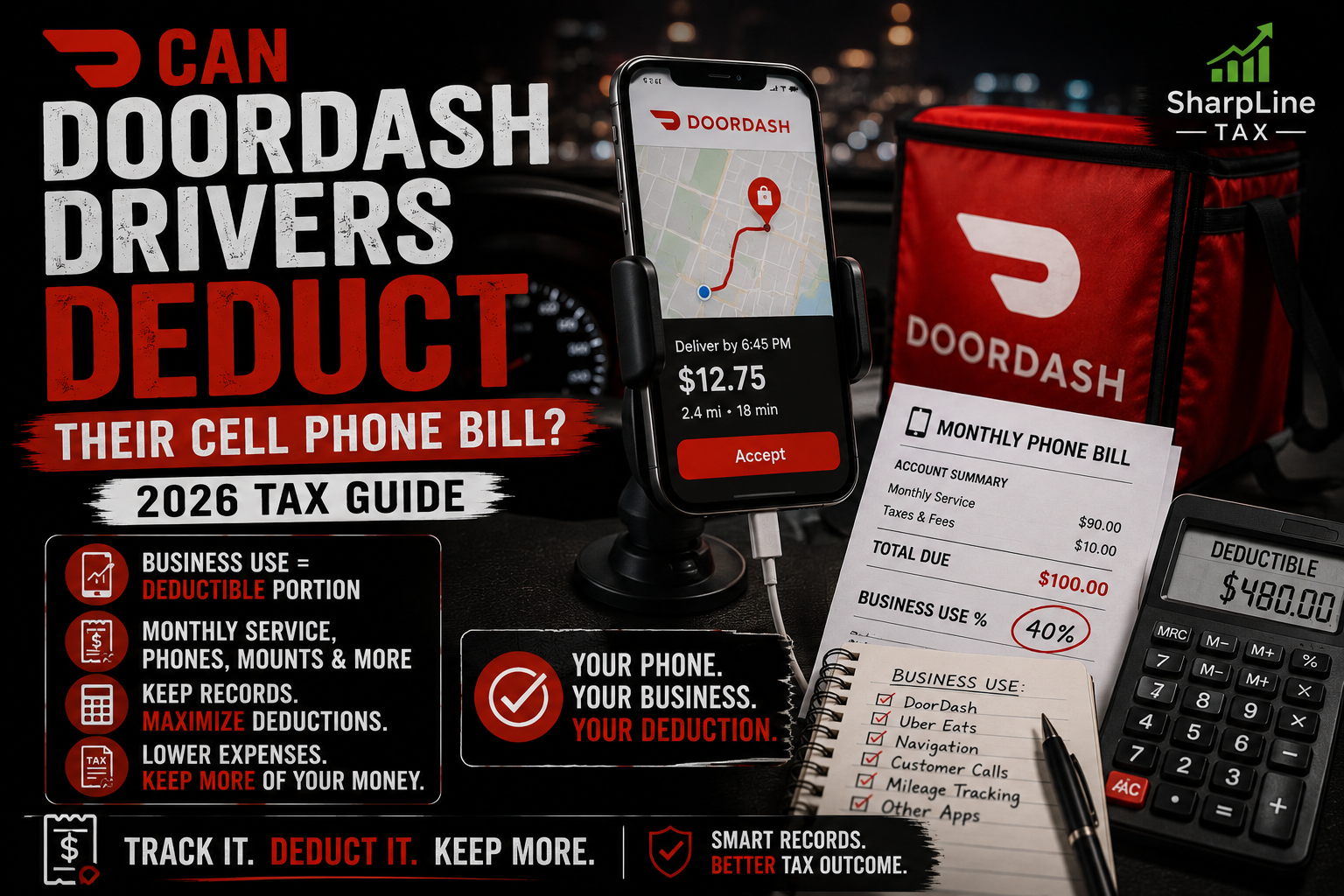
Suppose you reasonably determine that 40% of your phone use relates to your gig business.
A simplified calculation would look like this:
$1,200 × 40% = $480
In this simplified example, the business-use portion would be $480.
You wouldn't simply deduct the entire $1,200 if a substantial portion of your phone use was personal.
How Do I Determine My Business-Use Percentage?
This is where good recordkeeping becomes important.
There isn't one universal percentage that every DoorDash driver should use.
Your business-use percentage should reflect your actual circumstances and be reasonable.
You might consider how much you use your phone for activities such as:
DoorDash
Uber Eats
Spark
Instacart
Grubhub
Amazon Flex
Business navigation
Customer communication
Mileage tracking
Other legitimate gig-business activities
Compare that with your personal phone use.
Don't simply pick an extremely high percentage because it creates a larger deduction.
Use a reasonable method that you can support with your records.
What If I Multi-App?
If you work for several gig platforms, your business phone use isn't necessarily limited to DoorDash.
For example, suppose you regularly use:
DoorDash
Uber Eats
and
Spark
All three may contribute to the business use of your phone.
You're determining how much of your phone use relates to your overall qualifying business activity—not necessarily calculating a separate phone deduction for every individual app.
What About Buying a New Phone?
The phone itself is different from your monthly service bill.
If you purchase a phone that you use in your business, the business-use portion of the device's cost may potentially qualify for tax treatment as a business expense or business property.
Exactly how the cost is handled can depend on factors including the cost of the phone, how it's used, and applicable tax rules.
The important point is that buying a $1,200 phone doesn't automatically mean you should deduct $1,200 just because you occasionally use DoorDash.
If the device has both business and personal use, that distinction matters.
Keep the receipt for the phone and records supporting its business use.
What If I Buy a Separate Phone Just for DoorDash?
This can make the business-versus-personal distinction much easier.
Suppose you maintain a second phone that is genuinely used exclusively for your gig business.
The business connection is much clearer than it would be for a personal phone that you use for everything from DoorDash to social media and personal calls.
You should still keep documentation showing the cost and business purpose of the phone and service.
Can I Deduct My Phone Mount?
Potentially.
A phone mount used for your delivery business is different from the monthly phone service itself.
Drivers commonly use phone mounts to safely view navigation and delivery information while working.
If you purchase a phone mount for your gig business, keep the receipt with your other business records.
What About Phone Chargers?
The same general concept applies.
Items purchased for your delivery business may potentially qualify as business expenses when they're ordinary and necessary for the business.
Examples could include:
Car chargers
Charging cables
Portable battery packs
Phone mounts
If something also has substantial personal use, that needs to be considered.
Does the Mileage Deduction Include My Phone Bill?
No.
This is an important distinction.
The standard mileage method relates to the business use of your vehicle.
Your qualifying cell phone expense is a separate type of business expense.
Using the standard mileage deduction does not automatically prevent you from deducting other legitimate non-vehicle business expenses.
That means an eligible DoorDash driver could potentially have:
Standard mileage deduction
plus
Business-use portion of cell phone expenses
plus
Other qualifying non-vehicle business expenses
These are different categories of business expenses.
Example: DoorDash Phone Deduction
Let's look at a simplified example.
Suppose you pay:
$90 per month for phone service
Your annual cost is:
$1,080
After reviewing your usage, you reasonably determine that:
35% is attributable to your gig business
The simplified calculation would be:
$1,080 × 35% = $378
The business-use portion of the service would be:
$378
The remaining personal portion wouldn't become a business deduction simply because you also use the phone for DoorDash.
What Records Should DoorDash Drivers Keep?
Keep documentation that helps support your deduction.
Useful records may include:
Monthly phone bills
Phone purchase receipt
Receipts for accessories
Records supporting your business-use percentage
DoorDash work records
Records from other gig platforms
Notes explaining how you determined your business percentage
You don't want to wait until tax season and randomly guess what percentage of your phone was used for business.
What If My Phone Is Included in a Family Plan?
Being on a family plan doesn't automatically prevent business use from being relevant.
But you need to determine what expense is actually attributable to you and then determine the appropriate business portion.
For example, don't take the entire cost of a four-person family phone plan and treat it as a DoorDash business expense simply because one phone on the plan is used for deliveries.
The deduction should reflect the actual qualifying business expense.
What If Someone Else Pays My Phone Bill?
Generally, you need to actually incur or pay a business expense to claim it as your business deduction.
If someone else pays the entire phone bill and you don't reimburse them, don't automatically treat that payment as an expense you personally paid for your DoorDash business.
Your particular facts matter.
Is My Phone Bill Reported on Schedule C?
DoorDash drivers operating as sole proprietors generally report their business income and qualifying business expenses on Schedule C.
Qualifying business phone expenses can generally be included with the appropriate business expenses on Schedule C.
Your business profit is generally calculated after subtracting allowable business expenses from business income.
That's one reason accurately tracking expenses matters.
Common DoorDash Cell Phone Deduction Mistakes
Avoid these common mistakes:
❌ Automatically deducting 100% of a personal phone bill
❌ Making up a business-use percentage at tax time
❌ Deducting the entire family phone plan
❌ Throwing away monthly phone statements
❌ Forgetting phone expenses because they're paid automatically every month
❌ Assuming the standard mileage deduction includes your phone bill
❌ Forgetting business use from other gig apps when determining your overall business usage
❌ Treating clearly personal phone use as a business expense
Frequently Asked Questions
Can DoorDash drivers deduct their phone bill?
Potentially, yes.
If your phone is used for your DoorDash business, the qualifying business-use portion of the expense may generally be deductible.
Can I deduct my entire phone bill?
Not automatically.
If you use the phone for both business and personal purposes, you generally need to separate the business portion from the personal portion.
What percentage of my phone bill can I deduct for DoorDash?
There isn't one percentage that applies to every driver.
Your deduction should reflect a reasonable business-use percentage based on your actual circumstances.
Can I deduct my phone bill if I use the standard mileage deduction?
Potentially, yes.
Your phone is a separate non-vehicle business expense. The standard mileage method doesn't automatically include your cell phone bill.
Can I deduct a phone mount for DoorDash?
A phone mount purchased for your delivery business may potentially qualify as an ordinary and necessary business expense.
Keep your receipt and records.
Can I deduct a new iPhone if I use it for DoorDash?
The business-use portion of a phone purchased for your business may potentially qualify for business tax treatment.
However, buying an expensive phone doesn't automatically make the entire purchase deductible if you also use the device personally.
Can I deduct my phone if I also drive for Uber Eats?
Potentially.
Business use can include qualifying activity across multiple gig platforms. You don't necessarily have to use the phone exclusively for DoorDash for business use to matter.
Related DoorDash Tax Resources
Have another DoorDash tax question?
Check out these SharpLine Tax guides:
The Complete DoorDash Tax Guide for 2026
The Complete Gig Worker Tax Guide for 2026
The Complete Mileage Deduction Guide for Gig Workers
Can DoorDash Drivers Deduct Gas?
Can DoorDash Drivers Deduct Car Insurance?
Do DoorDash Drivers Pay Self-Employment Tax?
DoorDash Taxes With a W-2 Job
Do I Have to Report DoorDash Income Under $600?
What Tax Forms Do DoorDash Drivers Need?
Need Help With Your DoorDash Taxes?
At SharpLine Tax, I specialize in tax preparation for gig workers and independent contractors.
Whether you drive for DoorDash, Uber Eats, Spark, Instacart, Amazon Flex, or multiple platforms, I can help you organize your income and business expenses and prepare your tax return.
Ready to get started? Contact SharpLine Tax today or explore the other free gig worker tax resources available on this website.
