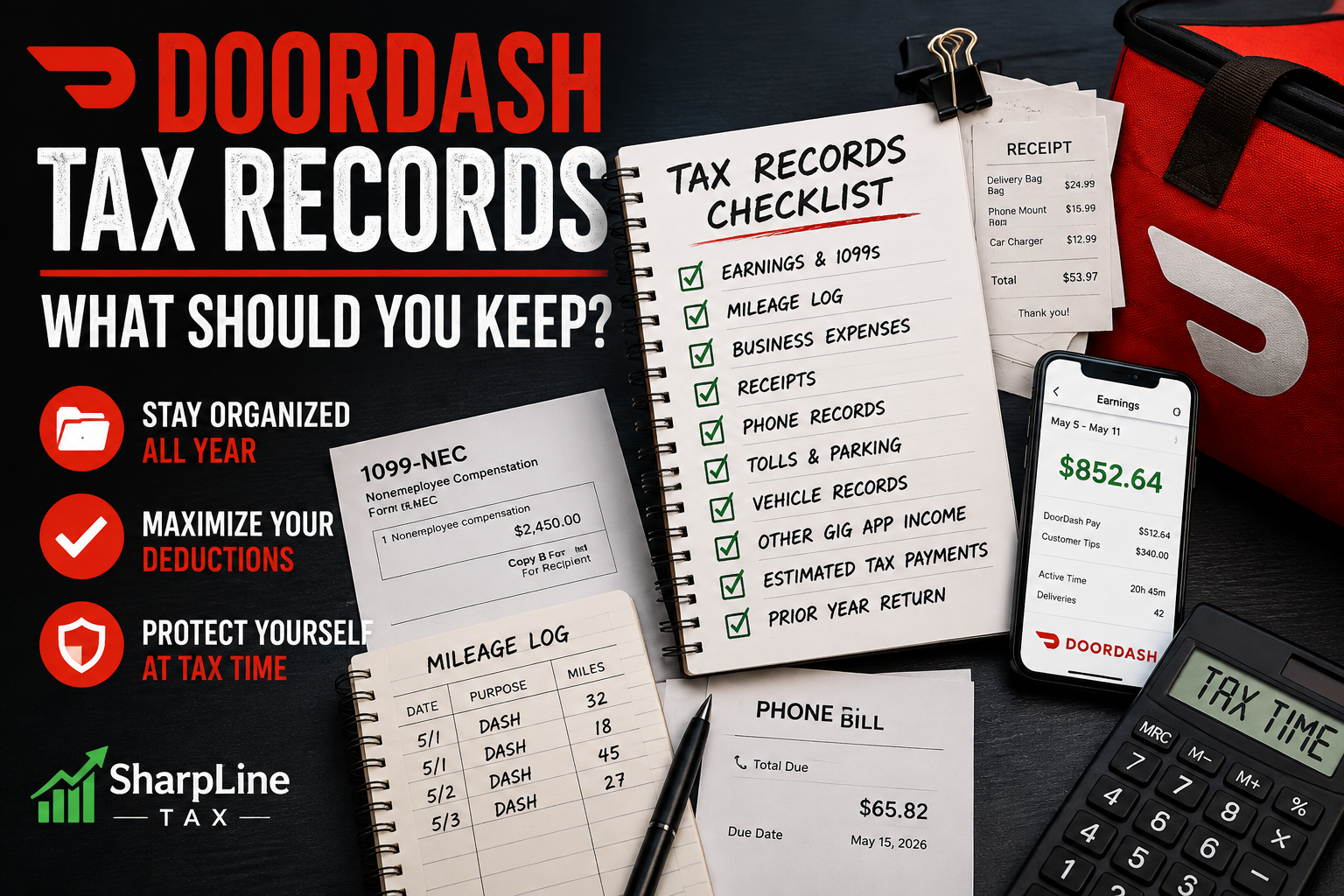
One of the easiest ways to make DoorDash taxes more difficult than they need to be is waiting until tax season to organize everything.
Suddenly you're searching through bank statements, trying to remember how many miles you drove, looking for old receipts, and wondering whether DoorDash sent you a tax form.
A much better approach is to keep a few important records throughout the year.
You don't need an overly complicated bookkeeping system.
You simply need records that clearly show your DoorDash income, business expenses, mileage, and other information needed to prepare and support your tax return.
Here's what DoorDash drivers should consider keeping for 2026.
Why Do DoorDash Drivers Need Tax Records?
DoorDash drivers are generally independent contractors.
That means you're essentially operating a small business when you deliver.
For many Dashers operating as sole proprietors, business income and expenses are reported on Schedule C.
Good records help you:
Determine your total business income
Track legitimate business expenses
Calculate your business profit
Prepare your tax return
Support deductions claimed on your return
Avoid forgetting expenses
Answer questions if the IRS ever examines your return
Your records don't need to be fancy.
They need to be accurate and organized.
1. Keep Your DoorDash Earnings Records
Start with your income.
Keep records showing how much you earned through DoorDash during the year.
Useful records can include:
DoorDash earnings summaries
Weekly payout information
Bank deposit records
Payment processor statements
Forms 1099 you receive
Other records showing payments from your delivery work
Don't rely entirely on receiving a 1099.
Gig economy income generally must still be reported even when you don't receive an information return.
Your own records should allow you to determine what you actually earned.
2. Keep Every 1099 You Receive
If DoorDash or a payment processor sends you a tax form, save it.
Depending on your circumstances, you could potentially receive forms such as:
Form 1099-NEC
Form 1099-K
Other applicable information returns
Don't throw these away after entering the numbers into tax software.
Keep them with your tax records for that year.
It's also a good idea to compare your tax forms with your own earnings records.
If something doesn't look right, investigate the difference before filing rather than automatically assuming the tax form or your records are correct.
3. Keep an Accurate Mileage Log
For many DoorDash drivers, mileage is one of the most important records they maintain.
If you're claiming a deduction for qualifying business vehicle use, you need records supporting that business use.
A useful mileage log should generally track information such as:
Date
Business purpose
Business miles driven
Depending on your situation, additional vehicle information may also be needed.
The important thing is to track your business driving consistently.
Don't wait until April and try to reconstruct an entire year of DoorDash mileage from memory.
4. Keep Mileage Records Even If DoorDash Shows You Mileage
DoorDash may provide mileage-related information, but I wouldn't recommend relying on one platform as your only mileage record.
Your actual qualifying business driving may not necessarily match a number provided by an app.
This becomes especially important if you:
Drive between delivery areas
Work multiple gig apps
Switch between DoorDash and Uber Eats
Drive for Spark or Instacart
Perform other qualifying business driving
Maintain your own accurate mileage records.
5. Keep Records From Every Gig App You Use
A lot of drivers don't work exclusively for DoorDash.
You might earn money from:
DoorDash
Uber Eats
Spark
Instacart
Grubhub
Amazon Flex
Uber
Lyft
Other gig platforms
Keep records from all of them.
Your tax return needs to account for your overall business activity, not just whichever app paid you the most money.
If you multi-app, having organized records becomes even more important.
6. Keep Receipts for Business Expenses
Save documentation for legitimate business expenses.
Depending on your situation, potential DoorDash business expenses could include items such as:
Phone mounts
Car chargers
Delivery bags
Certain business software
Business-use portion of qualifying phone expenses
Qualifying tolls
Qualifying parking
Other ordinary and necessary business expenses
A bank or credit card statement can help establish that you paid something, but don't assume proof of payment alone always establishes that an item qualifies as a business deduction.
Receipts and invoices can provide additional information about what you actually purchased.
7. Keep Your Cell Phone Records
Your phone is one of the primary tools used to run a delivery business.
You use it to:
Accept orders
Navigate
Contact customers
Take delivery photos
Track mileage
Manage earnings
Run multiple gig apps
If you're claiming the qualifying business-use portion of your phone expenses, keep documentation such as:
Monthly phone bills
Phone purchase receipts
Accessory receipts
Records supporting how you determined your business-use percentage
Don't automatically assume 100% of a personal phone bill is a business expense.
If your phone has both personal and business use, that distinction matters.
8. Keep Vehicle Expense Records If You Use the Actual Expense Method
DoorDash drivers generally need to understand the difference between the standard mileage method and actual vehicle expenses.
If you're using the actual expense method, you'll need much more detailed vehicle records.
Depending on your situation, these could include:
Gas receipts
Insurance statements
Repair bills
Maintenance receipts
Tire purchases
Registration costs
Lease records
Vehicle purchase records
Depreciation information
Other applicable vehicle expenses
You'll also need records supporting the business versus personal use of the vehicle.
If you use the standard mileage method instead, you generally don't separately deduct vehicle operating expenses already incorporated into the mileage rate.
9. Keep Vehicle Purchase Records
If you purchase a vehicle and use it for your gig business, don't throw away the purchase documents.
Keep records showing information such as:
Purchase date
Purchase price
Financing information
Trade-in information when applicable
Improvements when relevant
Business use
Records related to depreciation when applicable
Sale or disposition information later
Vehicle records can matter for more than just this year's deduction.
They may affect depreciation, basis, and the tax consequences when the vehicle is eventually sold or otherwise disposed of.
10. Keep Records of Tolls and Parking
Qualifying business tolls and parking fees can be easy to overlook.
Keep:
Toll statements
Parking receipts
Electronic toll records
Notes identifying the business purpose when necessary
Don't automatically treat every toll or parking charge as a business expense simply because you're a DoorDash driver.
The expense needs to relate to your business activity.
11. Keep Records of Estimated Tax Payments
If you make federal or state estimated tax payments during the year, save records of them.
Keep information showing:
Date paid
Amount paid
Which tax authority received the payment
Tax year the payment applies to
Confirmation or payment record
You don't want to get to tax season and wonder whether you made three estimated payments or four.
12. Keep Your W-2 If You Also Have a Regular Job
Many DoorDash drivers also work a traditional job.
If that's you, keep your Form W-2 with the rest of your tax documents.
Your W-2 wages and DoorDash business activity generally become part of the same individual federal income tax return.
The tax withholding shown on your W-2 can also be important when determining your overall tax liability.
13. Keep Your Previous Tax Returns
Don't throw away your tax return as soon as you've filed it.
Keep copies of your filed returns.
Prior-year returns can be useful when:
Preparing future returns
Reviewing depreciation
Checking carryovers
Comparing income
Amending a return
Answering questions about previously reported items
Keeping digital copies can make this extremely easy.
Paper Records vs. Digital Records
You don't necessarily need a filing cabinet full of paper.
Electronic recordkeeping can work perfectly well when properly maintained.
For example, you could create a folder for:
2026 DoorDash Taxes
Inside that folder, create subfolders such as:
Income
1099s
Mileage
Phone
Vehicle
Tolls & Parking
Business Expenses
Estimated Tax Payments
Take pictures or scan paper receipts and save them in the appropriate folder.
Whatever system you choose, make sure the records remain accurate, readable, organized, and accessible.
A Simple Monthly DoorDash Recordkeeping Routine
You don't need to spend hours every week doing bookkeeping.
Consider setting aside a few minutes at the end of each month.
Once a month:
1. Download or review your DoorDash earnings
Make sure your income records are complete.
2. Review your mileage log
Make sure trips are properly classified.
3. Save business receipts
Upload pictures or digital receipts to your tax folder.
4. Review other gig apps
Make sure income from Uber Eats, Spark, Instacart, or other platforms is recorded.
5. Save relevant phone and vehicle records
Don't wait until tax season to find them.
Ten or fifteen minutes of organization every month can potentially save you hours of frustration at tax time.
How Long Should DoorDash Drivers Keep Tax Records?
There isn't one retention period that applies to every tax document in every situation.
The IRS generally says records supporting income, deductions, or credits should be kept until the applicable period of limitations for the tax return expires.
For many ordinary federal income tax situations, that period is three years, but longer periods apply in certain circumstances.
For example, the IRS generally lists:
3 years for many ordinary situations
6 years in certain situations involving substantial unreported income
7 years for certain worthless-security or bad-debt loss claims
Indefinitely in certain situations involving no return or a fraudulent return
Records connected to property may need to be kept considerably longer because they can be needed to establish basis, depreciation, and gain or loss when the property is eventually disposed of.
So don't simply throw away every business record exactly three years after you receive it without considering what the document relates to.
DoorDash Tax Record Checklist
Before filing your DoorDash taxes, make sure you've gathered the records that apply to you.
Income
☐ DoorDash earnings records
☐ Forms 1099
☐ Bank/payment records
☐ Income from other gig platforms
Vehicle
☐ Mileage log
☐ Vehicle information
☐ Vehicle purchase records when applicable
☐ Actual vehicle expense records if using that method
☐ Tolls and parking records
Other Business Expenses
☐ Cell phone bills
☐ Phone/accessory receipts
☐ Delivery equipment receipts
☐ Business software expenses
☐ Other legitimate business expense receipts
Other Tax Documents
☐ W-2s from regular jobs
☐ Estimated tax payment records
☐ Prior-year tax return
☐ State and local tax documents when applicable
You may not need every item on this list.
The records you need depend on your particular tax situation.
Common DoorDash Recordkeeping Mistakes
Avoid these common mistakes:
❌ Waiting until tax season to recreate your mileage
❌ Assuming DoorDash keeps every record you need
❌ Throwing away receipts after buying business equipment
❌ Tracking DoorDash income but forgetting other gig apps
❌ Keeping income records but no expense documentation
❌ Automatically treating personal expenses as business expenses
❌ Losing estimated tax payment confirmations
❌ Throwing away vehicle purchase documents
❌ Assuming a bank statement by itself proves every business deduction
❌ Keeping records on an old phone without backing them up
❌ Throwing away every tax record after exactly three years without considering whether a longer retention period applies
Frequently Asked Questions
Do DoorDash drivers need to keep receipts?
You should maintain records supporting the business expenses you claim.
Receipts, invoices, account statements, and other supporting documents can help establish what you purchased, how much you paid, and the business nature of the expense.
Do I need to keep gas receipts if I use the standard mileage method?
If you're using the standard mileage method, you generally don't separately deduct gas because vehicle operating costs are incorporated into the mileage rate.
Your mileage records become particularly important under that method.
You may still have other reasons to retain certain vehicle records depending on your circumstances.
Does DoorDash track all the mileage I can deduct?
Don't assume DoorDash's mileage information represents every qualifying business mile you're entitled to claim.
Maintain your own accurate mileage records.
Can I keep digital receipts?
Electronic records can be used as part of a recordkeeping system.
Make sure your records are accurate, readable, organized, and accessible.
Do I need a separate bank account for DoorDash?
A separate business bank account can make bookkeeping easier, but operating as a sole proprietor doesn't automatically mean you need a separate account simply to file your federal income taxes.
The important thing is having records that clearly identify your business income and expenses.
How long should I keep DoorDash tax records?
For many ordinary federal income tax situations, three years is an important general period, but some records need to be retained longer.
Property records, certain special tax situations, and other circumstances can require longer retention.
Should I keep my old tax returns?
Yes.
Keeping copies of filed tax returns can help when preparing future returns or if you later need to amend a return or review previously reported information.
Related DoorDash Tax Resources
Have another DoorDash tax question?
Check out these SharpLine Tax guides:
How to File DoorDash Taxes for the First Time
The Complete DoorDash Tax Guide for 2026
The Complete Gig Worker Tax Guide for 2026
The Complete Mileage Deduction Guide for Gig Workers
What Tax Forms Do DoorDash Drivers Need?
What Happens If DoorDash Doesn't Send You a 1099?
DoorDash Taxes With a W-2 Job
Do DoorDash Drivers Pay Self-Employment Tax?
Can DoorDash Drivers Deduct Gas?
Can DoorDash Drivers Deduct Car Insurance?
Can DoorDash Drivers Deduct Their Cell Phone Bill?
Need Help Filing Your DoorDash Taxes?
Keeping good records throughout the year can make filing your DoorDash taxes much easier.
The key is having accurate records of your income, mileage, and business expenses and understanding how your DoorDash activity fits into your overall tax return.
At SharpLine Tax, I specialize in tax preparation for gig workers and independent contractors.
Whether DoorDash is your full-time income, a weekend side hustle, or one of several gig apps you use, I can help you organize your tax information and prepare your return.
Ready to stop guessing and get your DoorDash taxes handled correctly? Get started with SharpLine Tax and let me help you make sure your income, mileage, and deductions are properly accounted for.
GET STARTED WITH TAX PREPARATION
