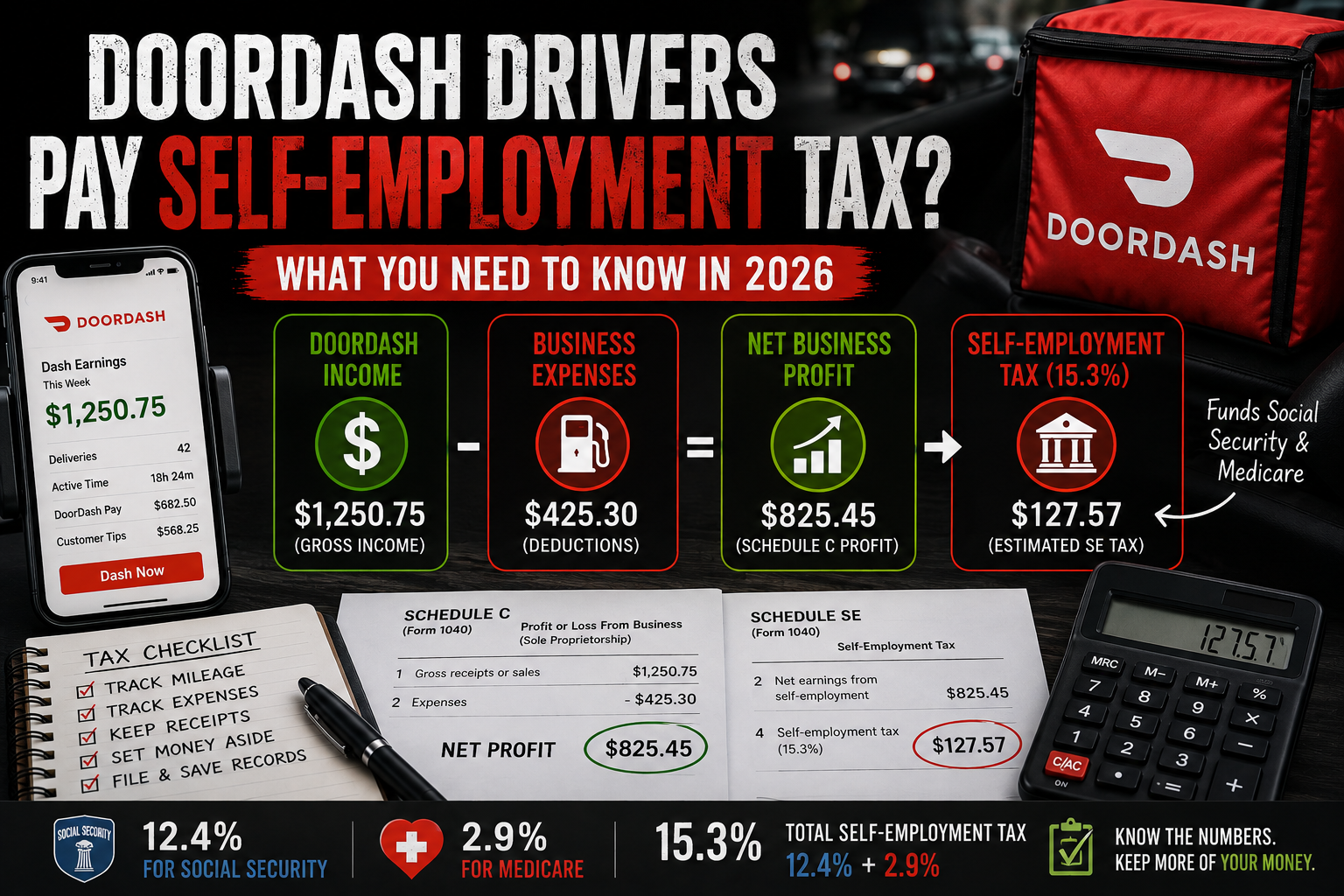
If you make money delivering for DoorDash, you may have heard that you have to pay a 15.3% self-employment tax.
That number can sound intimidating—especially if you're new to gig work.
But does DoorDash automatically take 15.3% of everything you earn?
No.
DoorDash drivers generally operate as independent contractors, which means their net earnings from the business may be subject to self-employment tax.
Here's what that actually means.
What Is Self-Employment Tax?
When you work a traditional W-2 job, Social Security and Medicare taxes are generally withheld from your paycheck.
Your employer also pays an employer share of those taxes.
When you're self-employed, there isn't an employer paying that share for your DoorDash business.
That's where self-employment tax comes in.
Self-employment tax generally consists of:
12.4% for Social Security
2.9% for Medicare
Together, that's the commonly referenced 15.3% self-employment tax rate.
Additional Medicare Tax can also apply to certain higher-income taxpayers.
Do DoorDash Drivers Have to Pay Self-Employment Tax?
Potentially, yes.
DoorDash drivers generally operate as independent contractors rather than employees.
Under IRS rules, if your net earnings from self-employment are $400 or more, you generally must file Schedule SE and calculate self-employment tax.
Notice that the rule refers to net earnings, not simply the amount DoorDash paid you.
That's an important distinction.
Is Self-Employment Tax Based on All My DoorDash Earnings?
No.
This is one of the biggest misconceptions among new DoorDash drivers.
Suppose DoorDash paid you:
$15,000
That doesn't necessarily mean self-employment tax is calculated directly on the entire $15,000.
Your DoorDash activity is a business.
A simplified calculation starts with:
Business income
minus
Allowable business expenses
equals
Net business profit
That business profit is then used as part of the calculation of your net earnings from self-employment.
A Simple DoorDash Example
Let's say you earned:
$15,000 from DoorDash
And you had:
$5,000 of allowable business expenses
Your simplified Schedule C profit would be:
$15,000 - $5,000 = $10,000
The self-employment tax calculation doesn't simply multiply the original $15,000 of DoorDash payments by 15.3%.
For Schedule SE purposes, generally 92.35% of your net self-employment earnings is used when calculating the regular Social Security and Medicare portion of self-employment tax.
Using this simplified example:
$10,000 × 92.35% = $9,235
Then:
$9,235 × 15.3% ≈ $1,413
So the estimated self-employment tax in this simplified example would be approximately $1,413, assuming no other factors change the calculation.
This example is for illustration only. Your actual tax calculation depends on your individual situation.
Self-Employment Tax Is NOT the Same as Income Tax
This is another important distinction.
Self-employment tax and federal income tax are two different taxes.
Self-employment tax primarily funds Social Security and Medicare.
Federal income tax is calculated separately based on factors including your:
Total income
Taxable income
Filing status
Deductions
Credits
Other tax circumstances
That means a DoorDash driver can potentially owe both self-employment tax and federal income tax on their business activity.
What If I Also Have a W-2 Job?
Having a W-2 job doesn't automatically eliminate self-employment tax on your DoorDash business.
You could have:
W-2 wages
plus
DoorDash business profit
on the same tax return.
However, your overall situation matters.
For example, Social Security tax has an annual wage base limit. Wages from your W-2 job can therefore affect the Social Security portion of your self-employment tax calculation when income becomes sufficiently high.
Taxes already withheld from your W-2 paycheck can also affect whether you ultimately receive a refund or owe additional money when you file.
For a deeper explanation, read our DoorDash Taxes With a W-2 Job: What You Need to Know in 2026 guide.
What If I Made Less Than $400 With DoorDash?
This is where it's important to distinguish between income reporting and the self-employment tax threshold.
The $400 figure relates to net earnings from self-employment and the general requirement to file Schedule SE.
It does not mean:
"If DoorDash paid me less than $400, I can automatically ignore the income."
Income may still need to be reported even when you don't owe self-employment tax on it.
Your overall filing situation matters.
What If DoorDash Doesn't Send Me a 1099?
Not receiving a 1099 doesn't automatically eliminate self-employment tax or your responsibility to report applicable income.
Your tax obligations are based on your actual tax situation—not simply whether a tax form arrives.
You should keep your own records of your DoorDash earnings.
If you're missing a tax form, see our What Happens If DoorDash Doesn't Send You a 1099? (2026 Guide).
Do Business Deductions Reduce Self-Employment Tax?
Legitimate business deductions can reduce your Schedule C business profit.
Because business profit affects the calculation of net earnings from self-employment, allowable business expenses can therefore affect your self-employment tax.
For delivery drivers, one of the most significant potential expenses is often the business use of a vehicle.
Rather than covering all of those deductions again here, see our Complete DoorDash Tax Guide for 2026 and Gig Worker Mileage Deduction Guide for more information.
Do I Get Any Deduction for Paying Self-Employment Tax?
Generally, yes.
When calculating adjusted gross income for federal income tax purposes, you can generally deduct the employer-equivalent portion of your self-employment tax.
This doesn't eliminate the self-employment tax itself.
Instead, it provides an income-tax deduction for part of the self-employment tax calculated on Schedule SE.
Common DoorDash Self-Employment Tax Mistakes
Avoid these common misconceptions:
❌ "DoorDash automatically takes taxes out for me."
❌ "I pay 15.3% of every dollar DoorDash sends me."
❌ "If I don't receive a 1099, I don't owe self-employment tax."
❌ "If I have a W-2 job, I don't have to pay self-employment tax."
❌ "The $400 threshold means the first $400 of DoorDash income is always tax-free."
❌ "Self-employment tax and federal income tax are the same thing."
Understanding these differences can make your DoorDash taxes much easier to plan for.
Frequently Asked Questions
What is the self-employment tax rate for DoorDash drivers?
The regular self-employment tax rate is generally 15.3%, consisting of 12.4% Social Security tax and 2.9% Medicare tax.
However, the calculation is more nuanced than simply multiplying all of your DoorDash payments by 15.3%.
Does DoorDash withhold self-employment tax?
DoorDash generally doesn't withhold Social Security and Medicare taxes from independent-contractor payments the way an employer does from W-2 wages.
Do I pay self-employment tax on gross DoorDash income?
Generally, the calculation is based on net earnings from self-employment, not simply your gross DoorDash receipts.
Your allowable business expenses are therefore important.
Do I owe self-employment tax if DoorDash is only a side hustle?
Potentially, yes.
Doing DoorDash part-time doesn't automatically exempt your business profit from self-employment tax.
Do I pay self-employment tax if I already have a full-time job?
Potentially, yes.
Having a W-2 job doesn't automatically eliminate self-employment tax on a separate DoorDash business, although your W-2 wages can affect certain parts of the calculation.
Is DoorDash income taxed twice?
Not in the sense that the exact same tax is simply charged twice.
Federal income tax and self-employment tax are different taxes calculated under different rules.
Related DoorDash Tax Resources
Have another DoorDash tax question?
Check out these SharpLine Tax guides:
The Complete DoorDash Tax Guide for 2026
The Complete Gig Worker Tax Guide for 2026
DoorDash Taxes With a W-2 Job: What You Need to Know in 2026
What Happens If DoorDash Doesn't Send You a 1099?
Can DoorDash Drivers Deduct Gas?
Can Gig Workers Deduct Their Cell Phone Bill?
The Complete Mileage Deduction Guide for Gig Workers
Need Help With Your DoorDash Taxes?
At SharpLine Tax, I specialize in tax preparation for gig workers and independent contractors.
If you earn money through DoorDash, Uber Eats, Spark, Instacart, Amazon Flex, Uber, Lyft, or multiple gig platforms, I can help you understand how your business income fits into your tax return and make sure you're claiming the legitimate business deductions you're entitled to.
Ready to get started? Contact SharpLine Tax today or explore the other free gig worker tax resources available on this website.
