If you drive for Walmart Spark, your vehicle is one of the biggest tools you use to make money.
That also means mileage can potentially be one of your largest business deductions.
Yes, Walmart Spark drivers may generally deduct qualifying business vehicle use.
But there's an important catch:
Not every mile you drive while doing Spark automatically qualifies as deductible business mileage.
Understanding which miles are business miles, keeping an accurate mileage log, and choosing the right vehicle-expense method can make a major difference at tax time.
Here's what Spark drivers should know about mileage deductions in 2026.
What Is the 2026 Mileage Rate for Spark Drivers?
The IRS changed the business mileage rate in the middle of 2026.
For qualifying business mileage, the standard mileage rates are:
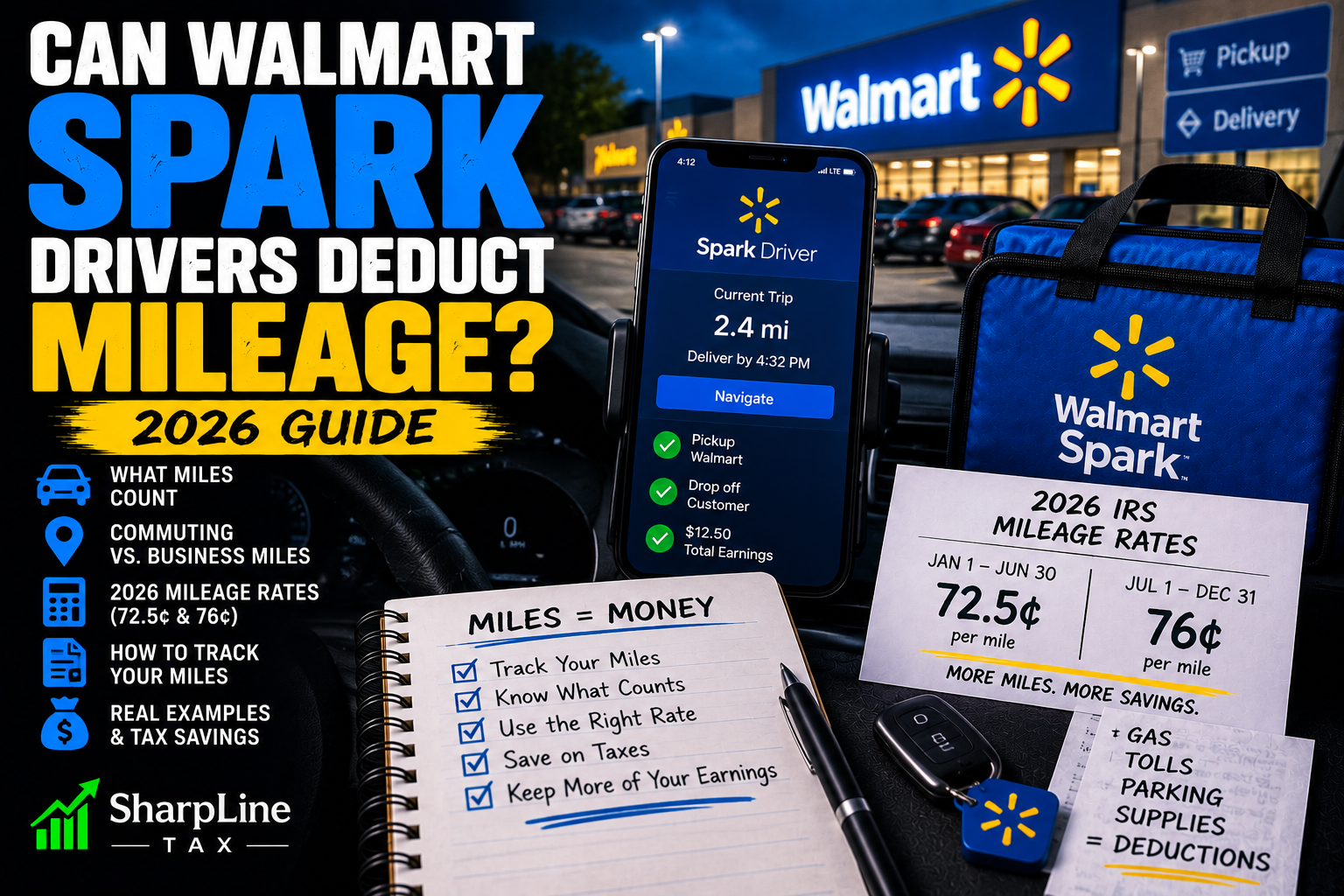
January 1 – June 30, 2026: 72.5¢ per mile
July 1 – December 31, 2026: 76¢ per mile
That means Spark drivers using the standard mileage method need to know when their business miles were driven, not simply their total mileage for the entire year.
Example
Suppose you drove:
5,000 qualifying business miles from January through June
5,000 × $0.725 = $3,625
Then you drove:
7,000 qualifying business miles from July through December
7,000 × $0.76 = $5,320
Your simplified standard-mileage deduction would be:
$8,945
That's a substantial business expense, which is why tracking mileage can be so important for delivery drivers.
What Spark Miles Can Be Business Miles?
Business transportation generally includes driving from one workplace to another during the course of your business and traveling to customers.
For a Spark delivery business, qualifying trips could potentially include driving:
From a Walmart pickup location to a customer's delivery location
From one customer delivery to another business location
From one Walmart location to another for business purposes
Between business pickups and deliveries
To other qualifying business locations while actively conducting your delivery business
The key is that the driving needs to have a legitimate business purpose.
Simply having the Spark app installed—or even turned on—doesn't automatically transform every mile you drive into a deductible business mile.
Is Driving From Home to Walmart Deductible?
This is where the answer becomes more complicated.
Don't automatically assume every trip from your house to Walmart is deductible.
The IRS generally considers transportation between your home and your regular or main place of work to be personal commuting, and commuting expenses generally aren't deductible.
There are exceptions depending on the facts.
For example, different rules can apply if your home qualifies as your principal place of business for tax purposes or when traveling to certain temporary work locations.
Gig work can create situations that aren't as simple as an employee driving to the same office every morning.
That's why you should look at the actual business purpose and circumstances of the trip, rather than using a rule like:
“My Spark app was on, so every mile counts.”
That isn't a reliable way to determine deductible mileage.
What About the Drive Home After Your Last Delivery?
The same commuting issue can arise at the end of your workday.
Don't automatically assume that every mile from your final delivery back to your house is deductible.
IRS transportation rules distinguish business transportation from personal commuting.
The facts of your particular business activity matter.
This is another reason an accurate mileage log is better than simply recording your car's odometer at the beginning and end of the year and calling every mile a business mile.
What If You Drive Between Walmart Stores?
If you're actively conducting your Spark delivery business and travel from one business location to another, those miles may generally qualify as business transportation.
For example, suppose you're working in one area and legitimately travel from one Walmart location to another as part of conducting your delivery business.
That's different from simply driving from home to your regular work area.
Keep records showing where you went and the business purpose of the trip.
What If You Multi-App With Spark, DoorDash and Uber Eats?
This is extremely common.
You might run:
Spark + DoorDash + Uber Eats
during the same shift.
That's fine from a mileage-recordkeeping perspective, but there's one important rule:
You can't deduct the same mile multiple times.
Suppose you drive 100 qualifying business miles during a shift while all three apps are active.
You drove:
100 business miles
Not:
100 Spark miles + 100 DoorDash miles + 100 Uber Eats miles = 300 miles
The deduction follows the actual qualifying business mileage driven.
You don't get to multiply the same physical miles by the number of apps running on your phone.
What About Personal Stops During a Spark Shift?
Personal driving generally isn't converted into business mileage simply because you're working that day.
Suppose you're making Spark deliveries and then drive several miles out of your way to handle a purely personal errand.
Those personal miles generally aren't business miles.
If you resume your business activity afterward, your records should distinguish between business and personal vehicle use.
Again, the goal isn't to label every mile as business mileage.
It's to accurately document your actual qualifying business use.
Standard Mileage vs. Actual Vehicle Expenses
Spark drivers generally need to understand two methods for calculating vehicle expenses.
Standard Mileage Method
If you're eligible, you multiply your qualifying business miles by the applicable IRS mileage rate.
For 2026:
72.5¢ per business mile for January through June
76¢ per business mile for July through December
The standard mileage rate is designed to account for vehicle operating costs.
That means you generally don't deduct your gas, insurance, repairs, maintenance, tires, depreciation and similar vehicle costs again on top of the standard mileage deduction.
Doing so could result in double-counting vehicle expenses.
Actual Expense Method
Instead of using the mileage rate, eligible taxpayers may calculate the business-use portion of their actual vehicle expenses.
Potential expenses can include:
Gas or EV charging
Insurance
Repairs
Maintenance
Tires
Registration
Depreciation
Qualifying lease expenses
Other eligible vehicle costs
If your vehicle is used for both Spark and personal driving, only the appropriate business-use portion is generally deductible.
There are additional eligibility rules associated with switching between the standard-mileage and actual-expense methods.
Can Spark Drivers Deduct Tolls and Parking?
Potentially, yes.
Business-related tolls and parking fees can generally be separately deductible, even when you're using the standard mileage method.
That's important because these costs aren't necessarily lost just because you chose standard mileage.
However, personal or commuting-related parking and tolls shouldn't automatically be treated as business expenses.
Keep records showing the business purpose.
What Records Should Spark Drivers Keep?
A good mileage log should allow you to substantiate your business vehicle use.
Consider keeping records of:
Date
Starting location
Destination
Business purpose
Business miles driven
You should also know your vehicle's total mileage for the year so you can distinguish business use from personal use when necessary.
You can track mileage using:
A mileage-tracking app
A spreadsheet
A written mileage log
The specific tool matters less than having accurate, consistent records.
Don't wait until tax season and try to guess how many miles you drove months earlier.
Should You Track Miles Even If You're Not Sure Which Method You'll Use?
Yes.
Tracking your business mileage gives you records you may need when determining your vehicle deduction.
If you fail to track your miles during the year, recreating an accurate mileage history later can become much harder.
Keeping records also gives you more information when comparing vehicle-expense methods if you're eligible to choose between them.
Where Does the Mileage Deduction Go?
For many Spark drivers operating as sole proprietors, vehicle expenses associated with their delivery business are generally reported as part of their business activity on Schedule C.
Your business expenses reduce your business profit.
A simplified example:
Spark income: $30,000
Allowable business expenses, including vehicle deduction: $11,000
Simplified business profit:
$19,000
That's one reason mileage can matter so much for delivery drivers.
The deduction doesn't mean the government simply sends you the amount of your mileage deduction.
Instead, qualifying business expenses generally reduce the profit used in calculating your taxes.
Common Spark Mileage Mistakes
Avoid these common mistakes:
❌ Not tracking mileage at all
❌ Trying to reconstruct an entire year's mileage at tax time
❌ Assuming every mile driven while the Spark app is open is deductible
❌ Automatically treating all driving between home and Walmart as business mileage
❌ Counting personal errands as business mileage
❌ Deducting the same mileage separately for Spark, DoorDash and Uber Eats
❌ Using standard mileage and then separately deducting vehicle expenses already incorporated into the mileage rate
❌ Forgetting that the 2026 mileage rate changed on July 1
❌ Failing to separate business and personal vehicle use
Frequently Asked Questions
Can Walmart Spark drivers write off mileage?
Qualifying business vehicle use may generally be deductible. Whether a particular trip qualifies depends on the purpose and circumstances of the driving.
What is the Spark mileage deduction for 2026?
There isn't a special Spark mileage rate.
The IRS standard business mileage rate is 72.5¢ per mile from January 1 through June 30, 2026, and 76¢ per mile from July 1 through December 31, 2026.
Does driving from Walmart to the customer count?
Driving from a business pickup location to a customer as part of performing your delivery work would generally be business transportation.
Can I deduct my drive from home to Walmart?
Don't automatically count it. Travel between your home and a regular or main work location can be nondeductible commuting. Exceptions can apply depending on your specific circumstances.
Can I deduct gas and mileage?
Generally, you shouldn't use the standard mileage method and then separately deduct gas and other vehicle operating expenses already incorporated into the mileage rate.
The actual-expense method works differently.
Can I deduct tolls and parking if I use mileage?
Qualifying business-related tolls and parking may generally be deducted separately from the standard mileage rate.
What if I use Spark and DoorDash during the same shift?
Track your actual qualifying business miles. You can't deduct the same mile twice simply because multiple delivery apps were running.
Does Spark track all the mileage I can deduct?
Don't rely solely on a gig platform to determine your tax deduction.
Your deductible business mileage is based on your actual qualifying vehicle use under the tax rules. Keep your own records.
The Bottom Line
For Walmart Spark drivers, mileage can potentially be one of the most valuable business deductions.
But the goal isn't to claim as many miles as possible.
The goal is to claim the qualifying business miles you can support with accurate records.
Remember:
Track your mileage throughout the year.
Separate business driving from personal driving.
Don't automatically count commuting miles.
Don't double-count miles when multi-apping.
Use the correct 2026 mileage rate for each half of the year.
A good mileage log can make your Spark taxes significantly easier when it's time to file.
Related Spark Tax Resources
The Complete Walmart Spark Driver Tax Guide for 2026
What Tax Forms Do Walmart Spark Drivers Get? 2026 Guide
Does Walmart Spark Take Taxes Out of Your Pay? 2026 Guide
How to File Taxes With DoorDash, Uber Eats & Spark Income
The Complete Mileage Deduction Guide for Gig Workers
Need Help Filing Your Spark Driver Taxes?
At SharpLine Tax, I specialize in tax preparation for gig workers and independent contractors.
Whether Spark is your full-time income, a weekend side hustle, or one of several delivery apps you use, I can help you organize your income, mileage, and business expenses and prepare your return.
Ready to stop guessing and get your Spark taxes handled correctly? Get started with SharpLine Tax and let me help you make sure your income, mileage, and deductions are properly accounted for.
