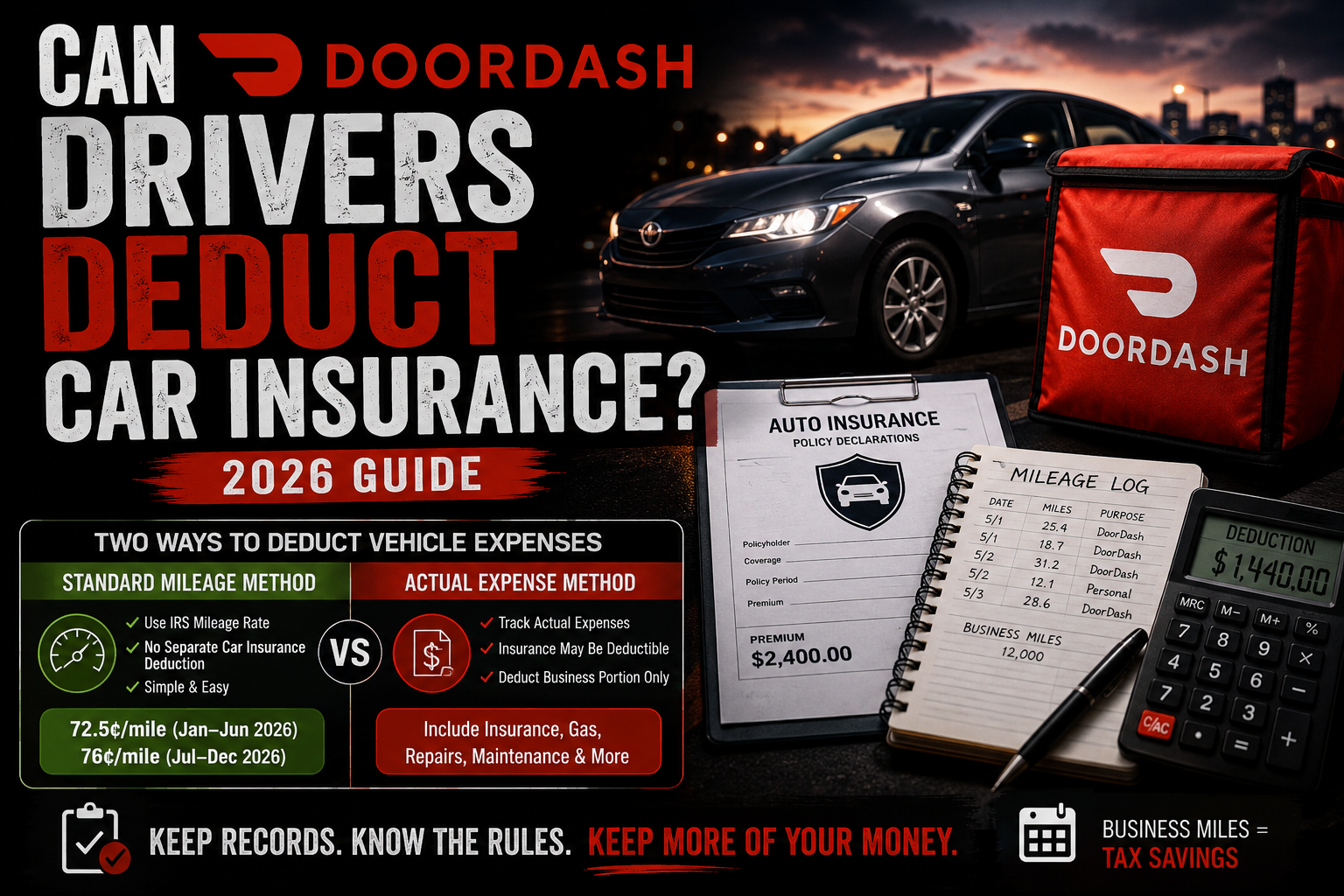
Car insurance can be a significant expense when you drive for DoorDash.
If you're putting thousands of miles on your vehicle making deliveries, you may be wondering:
Can I deduct my car insurance on my taxes?
Potentially—but it depends on which method you use to deduct your vehicle expenses.
The biggest thing DoorDash drivers need to understand is the difference between the standard mileage method and the actual expense method.
Here's how it works.
Can DoorDash Drivers Write Off Car Insurance?
If you use the actual expense method, the business-use portion of your car insurance may generally be included as a vehicle expense.
However, if you use the standard mileage method, you generally cannot deduct your car insurance separately.
That's because insurance is one of the vehicle costs accounted for by the standard mileage method.
In other words:
Standard mileage method = no separate car insurance deduction
Actual expense method = business portion of car insurance may be deductible
You don't get to deduct the same vehicle expense twice.
How the Standard Mileage Method Works
The standard mileage method allows eligible taxpayers to calculate their vehicle deduction based on their qualifying business miles rather than individually deducting many of their actual vehicle operating expenses.
For 2026, the business mileage rate is:
January 1 through June 30, 2026: 72.5 cents per business mile
July 1 through December 31, 2026: 76 cents per business mile
The IRS increased the rate beginning July 1, 2026.
If you're using the standard mileage method, expenses such as these generally aren't deducted separately:
Car insurance
Gas
Oil
Repairs
Maintenance
Tires
Vehicle registration fees
Depreciation
Lease payments
That's why keeping an accurate mileage log is so important for DoorDash drivers who use this method.
How the Actual Expense Method Works
The other option is the actual expense method.
Instead of multiplying your qualifying business mileage by the IRS mileage rate, you track the actual costs of operating your vehicle.
Potential vehicle expenses can include:
Car insurance
Gas
Oil
Repairs
Maintenance
Tires
Registration fees
Depreciation
Lease payments, when applicable
But there's an important catch.
If you also use your vehicle personally, you generally can't deduct 100% of these expenses.
You need to determine the portion attributable to business use.
How Much of Your Car Insurance Can You Deduct?
Let's look at a simplified example.
Suppose your annual car insurance costs:
$2,400
During the year, you drive:
20,000 total miles
Of those:
12,000 are qualifying business miles
That means your vehicle was used 60% for business based on mileage in this simplified example.
If you're using the actual expense method:
$2,400 × 60% = $1,440
The business portion of the insurance expense would therefore be $1,440 in this simplified example.
You wouldn't simply deduct the entire $2,400 if 40% of the vehicle use was personal.
What If I Only Use My Car for DoorDash?
Even if DoorDash is the primary reason you drive the vehicle, make sure you're separating business use from personal use.
Personal driving generally isn't transformed into business mileage simply because you also use the same car for DoorDash.
Your records should distinguish between business and personal use.
Can I Deduct Insurance AND Mileage?
Generally, no.
If you're using the standard mileage method, you generally cannot take an additional deduction for your car insurance.
The IRS standard mileage rate already accounts for vehicle operating costs.
This is the same reason you generally can't use the standard mileage deduction and then separately deduct your gas, repairs, tires, or oil.
That would effectively result in deducting some vehicle costs twice.
Can I Deduct Tolls and Parking With the Mileage Method?
This is an important exception.
Business-related parking fees and tolls may generally be deductible separately even when you're using the standard mileage method.
So don't assume that every vehicle-related expense is automatically included in the mileage rate.
Keep records of qualifying business tolls and parking expenses.
Standard Mileage vs. Actual Expenses: Which Is Better?
There isn't one method that's automatically better for every DoorDash driver.
The standard mileage method can be attractive because it's relatively simple.
You primarily need good records of your qualifying business mileage.
The actual expense method requires considerably more recordkeeping because you're tracking vehicle expenses throughout the year and determining the business-use portion.
However, depending on your vehicle costs and business usage, the actual expense method could potentially produce a different deduction.
If you're eligible to use either method, comparing the two can help determine which makes more sense for your situation.
There are also rules governing when you can choose or switch methods, so don't assume you can freely change methods in every situation.
What Insurance Records Should DoorDash Drivers Keep?
If you're using or considering the actual expense method, keep good documentation.
Useful records may include:
Insurance statements
Proof of payments
Policy documents
Mileage logs
Beginning and ending odometer readings
Records showing business versus personal mileage
Good records can help establish both the amount you paid and the business-use percentage of your vehicle.
Does Rideshare or Delivery Insurance Change the Tax Deduction?
The tax treatment of an insurance expense and whether your insurance policy provides appropriate coverage are separate issues.
If you purchase additional insurance specifically related to your delivery business, keep records of what you paid and what the coverage is for.
Don't assume that your personal auto policy automatically provides all of the coverage you need while making deliveries.
Your insurance company can explain what coverage applies to your particular policy and delivery activity.
What If I Have More Than One Gig App?
The same general vehicle-expense concepts can apply if you drive for multiple platforms.
For example, you might drive for:
DoorDash
Uber Eats
Spark
Instacart
Grubhub
Amazon Flex
Your business use isn't necessarily limited to miles driven for one platform.
What matters is properly identifying and documenting qualifying business use.
Common Car Insurance Deduction Mistakes
Avoid these common mistakes:
❌ Deducting car insurance separately while also using the standard mileage method
❌ Deducting 100% of insurance when the vehicle is also used personally
❌ Failing to track business mileage
❌ Assuming all driving is automatically business mileage
❌ Throwing away insurance and vehicle-expense records
❌ Deducting both standard mileage and actual vehicle expenses for the same vehicle use
❌ Choosing a vehicle deduction method without understanding the rules
Frequently Asked Questions
Can I deduct my full car insurance bill for DoorDash?
Not necessarily.
If you use the actual expense method and also use your vehicle personally, you generally need to allocate the expense between business and personal use.
Can I deduct car insurance if I use the standard mileage deduction?
Generally, no.
Car insurance is one of the actual vehicle expenses you generally cannot deduct separately when using the standard mileage method.
Can I deduct gas and car insurance together?
Potentially, if you're properly using the actual expense method.
Both gas and insurance can be actual vehicle expenses, but only the applicable business portion is generally deductible when the vehicle has both business and personal use.
If you're using standard mileage, you generally don't deduct either gas or insurance separately.
What is the DoorDash mileage rate for 2026?
The IRS business standard mileage rate is 72.5 cents per mile for January 1 through June 30, 2026 and 76 cents per mile for July 1 through December 31, 2026.
Is mileage or actual expenses better for DoorDash?
It depends on your particular vehicle, expenses, business mileage, and eligibility to use each method.
Keeping complete mileage and expense records can make it easier to evaluate your options.
Related DoorDash Tax Resources
Have another DoorDash tax question?
Check out these SharpLine Tax guides:
The Complete DoorDash Tax Guide for 2026
The Complete Gig Worker Tax Guide for 2026
The Complete Mileage Deduction Guide for Gig Workers
Can DoorDash Drivers Deduct Gas?
Do DoorDash Drivers Pay Self-Employment Tax?
DoorDash Taxes With a W-2 Job
What Tax Forms Do DoorDash Drivers Need?
Need Help With Your DoorDash Taxes?
At SharpLine Tax, I specialize in tax preparation for gig workers and independent contractors.
If you drive for DoorDash, Uber Eats, Spark, Instacart, Amazon Flex, or other gig platforms, I can help you organize your business income and expenses and determine how they should be reported on your tax return.
Ready to get started? Contact SharpLine Tax today or explore the other free gig worker tax resources available on this website.
