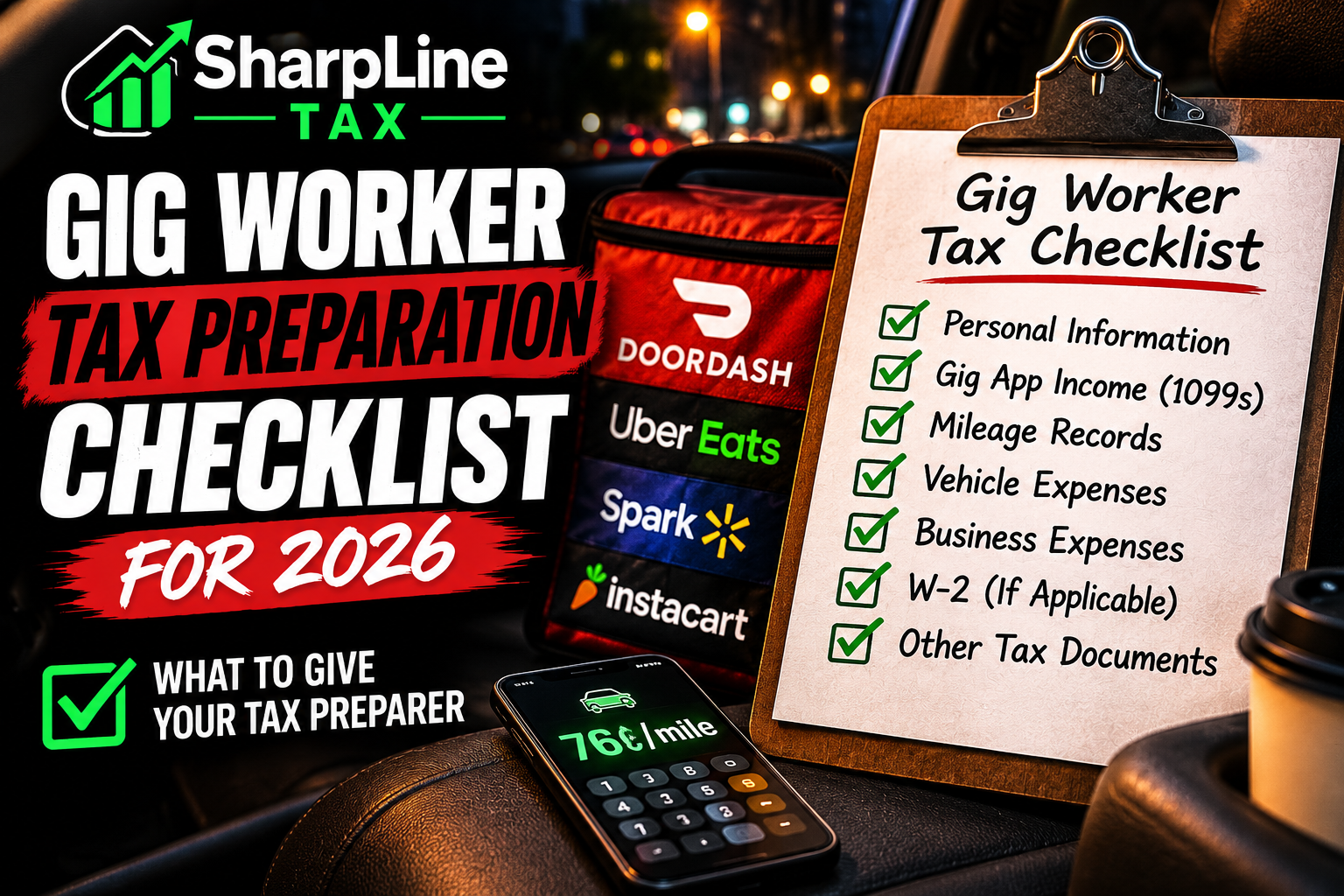
Getting ready to file your taxes as a DoorDash, Uber Eats, Walmart Spark, or Instacart driver?
Whether you deliver full-time or earn extra money on the side, having the right documents ready can make tax preparation much easier.
Unlike traditional W-2 employees, gig workers are generally responsible for reporting their self-employment income and keeping records of their business expenses.
At SharpLine Tax, I work with gig workers and independent contractors to help them organize their tax information and prepare their returns.
Use this free checklist to get everything ready before submitting your documents.
1. Personal Information
Start with the basic information needed to prepare your tax return.
Full legal name
Social Security number or ITIN
Date of birth
Current mailing address
Filing status
Spouse's information, if filing jointly
Dependent information, if applicable
Bank routing and account numbers for direct deposit
Copy of your previous year's tax return, if available
Tip: If you're a returning client, let your tax preparer know about any major changes, such as getting married, having a child, or moving to another state.
2. Gig Worker Income Documents
If you worked for delivery apps during 2026, gather your earnings information from every platform you used.
DoorDash earnings statement or tax forms
Uber Eats earnings statement or tax forms
Walmart Spark earnings statement or tax forms
Instacart earnings statement or tax forms
Roadie or other delivery-app income
Forms 1099-NEC, 1099-K, or other applicable tax forms
Annual earnings summaries
Records of tips, bonuses, and incentives not already included in your reported earnings
Records of any other independent contractor income
Important: You generally must report taxable gig income even if you don't receive a 1099.
If you worked for multiple apps, provide income information for every platform, not just the one where you earned the most.
3. Business Mileage Records
For many delivery drivers, mileage is one of the largest potential tax deductions.
Your tax preparer needs accurate records of your qualifying business miles.
Total business miles driven during 2026
Mileage tracking app reports or spreadsheet
Dates and purposes of business trips
Vehicle's beginning-of-year odometer reading
Vehicle's end-of-year odometer reading
Total miles driven during the year
Vehicle make, model, and year
Date the vehicle was first used for business
2026 IRS Business Mileage Rates
For qualifying business miles driven in 2026:
January 1 – June 30: 72.5 cents per mile
July 1 – December 31: 76 cents per mile
If you drove for multiple delivery apps, you should provide your combined qualifying business mileage without counting the same miles twice.
Don't have a mileage log?
Let your tax preparer know. Available delivery records, trip histories, calendars, and other documentation may help reconstruct mileage, but deductions must be supported by reasonable, reliable records.
4. Vehicle Expenses
Your tax preparer may need information about your vehicle expenses to evaluate the appropriate deduction method.
Gather records for:
Gasoline or EV charging expenses
Vehicle insurance
Repairs and maintenance
Tires
Oil changes
Registration fees
Vehicle loan interest
Vehicle purchase or lease documents
Parking fees related to business
Business-related tolls
Important: You generally cannot deduct the same vehicle operating expenses separately if you're using the standard mileage method.
Your tax preparer can help determine which expenses qualify and which vehicle deduction method is available for your situation.
5. Other Business Expenses
Gig workers may have deductible business expenses beyond their vehicle.
Gather receipts or records for applicable purchases.
Business-use portion of cell phone bills
Phone mounts and chargers
Insulated delivery bags
Delivery equipment and supplies
Business-related software subscriptions
Mileage tracking apps
Other ordinary and necessary business expenses
For expenses used for both personal and business purposes, provide the business-use percentage or information needed to calculate it.
For example, if you use your personal phone for DoorDash and everyday personal activities, the entire phone bill isn't automatically deductible.
6. W-2 Income and Other Tax Documents
Many gig workers also have regular jobs.
If you worked a W-2 job while delivering, you'll need to provide those documents too.
Forms W-2 from employers
Forms 1099-INT for interest income
Forms 1099-DIV for dividend income
Other 1099 income documents
Unemployment compensation documents, if applicable
Retirement income documents, if applicable
Health insurance Marketplace Form 1095-A, if applicable
Other tax documents relevant to your return
Remember: Your tax preparer needs information about your entire tax situation, not just your delivery income.
7. Tax Payments and Potential Deductions
If you made tax payments during the year or have other deductions and credits, gather the supporting information.
Federal estimated tax payments
State estimated tax payments
Mortgage interest statement, if applicable
Property tax records
Charitable contribution records
Student loan interest statement
Eligible education expenses
Eligible retirement contributions
Eligible health insurance information
Childcare expense information, if applicable
Not every document will apply to every taxpayer.
Your tax preparer can determine which information is relevant.
8. Final Checklist Before Submitting Your Documents
Before sending your information to SharpLine Tax, make sure you have:
Included income from every gig app
Gathered all available tax forms
Provided your business mileage records
Organized your business expenses
Included W-2s and other income documents
Provided estimated tax payment information
Included last year's tax return, if available
Checked for missing or incorrect information
You don't need to know how to complete Schedule C yourself.
That's what your tax preparer is there to help with.
Your responsibility is to provide accurate and complete information so your return can be prepared correctly.
Frequently Asked Questions
Do I Need a 1099 to File My DoorDash or Spark Taxes?
No. You generally must report taxable gig income even if you don't receive a 1099.
Your annual earnings statements and other reliable income records can help document your income.
What If I Worked for Multiple Delivery Apps?
Provide income records from every app.
If your activities are part of the same delivery business, they may generally be reported together on one Schedule C.
What If I Didn't Track My Mileage?
Tell your tax preparer before filing.
You may be able to reconstruct qualifying mileage using reliable supporting documentation, but you shouldn't simply guess at a deduction.
Do I Need to Save Every Gas Receipt?
It depends on your vehicle deduction method.
If you use the standard mileage method, gasoline is generally already included in the mileage rate.
If you use actual vehicle expenses, documentation of qualifying expenses becomes especially important.
Can I File Gig Worker Taxes If I Also Have a W-2 Job?
Yes.
Many gig workers have traditional employment and earn additional income through delivery apps.
Your W-2 wages and self-employment activity are generally reported together on your individual federal income tax return.
Ready to File Your Gig Worker Taxes?
At SharpLine Tax, I provide remote tax preparation for DoorDash, Uber Eats, Walmart Spark, Instacart, and other independent contractors.
Whether you deliver full-time, work multiple apps, or have a W-2 job alongside your gig income, I can help you organize your documents and prepare your return.
You don't have to figure out every tax form and deduction on your own.
Get started today and let SharpLine Tax help you prepare for tax season.
